

2. Collect information about time measuring devices that were used in the ancient times in different parts of the world. Prepare a brief write up on each one of them. The write up may include the name of the device, the place of its origin, the period when it was used, the unit in which the time was measured by it and a drawing or photograph of the device, if available.
Answer:
Many different types of time measuring devices were invented in various parts of the world in ancient times. A lot of them are remarkable in design and makes you wonder how ingenious our ancestors were in their thinking and also what wonderful inventions are in store for us in the future. Let us take you back in time to explore some of these amazing devices and help inspire your thinking!

(a) Ancient Sundial in Forbidden City, Beijing: The sundial was carved in the early 15th century when the Forbidden city was built. Do you see the gnomon (which points in the North-South direction) in the middle casting the long shadow which tell us the time? The circular plate is made of marble and the scale suggests that the unit in which time was measured was ‘hour’.
(b) Ancient Sundial in Jaisalmer Fort, Rajasthan, India: This ancient sundial adorns the Jaisalmer fort in Rajasthan since 1861 CE. Do you see the straight groove in the middle of the plate? That was used for attaching the triangular gnomon which cast the shadow to reveal the correct time. The divisions are equally spaced and each equal time interval was of 24 minutes or 1 ‘ghat’ which was a unit of time measurement used in India.
(c) Ancient Sundial called Angbu-ilgu in Seoul, South Korea: King Sejong ordered this sundial called Angbu-ilgu to be created in 1434. In addition to telling time it also provides useful astronomical information. The concave design you see in Figure (c) further helps to accurately estimate time and identify the particular solar term (which represents a certain astronomical event in the Chinese lunisolar calendar). The unit in which time was measured was ‘hour’ – the seven vertical lines you see in the figure represented the 14 hours of sunlight everyday. The horizontal lines were used to measure the length of the shadow based on which the current solar term was identified. Simple and ingenious!
Incense Clocks
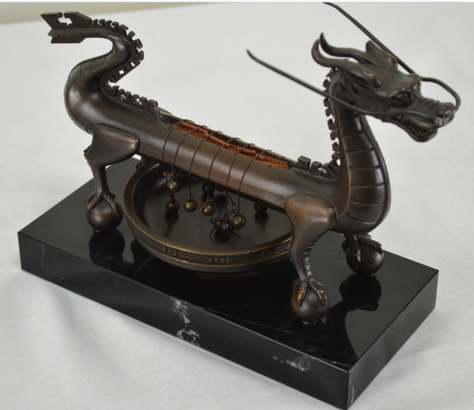
Incense clocks were used in ancient times in China starting from the 6th century AD. Specifically dragon boat incense clocks are estimated to be invented in China during 618 – 907 AD and spread to Japan.
In the model of the Japanese Dragon Boat Incense Clock shown above, the incense is laid out inside the body of the dragon. Once the incense is lit, the fire travels through the incense at the rate of 2 inches/hour and burns the silk threads from which the brass balls hang. The sound of the brass balls dropping on the gong beneath the dragon signals the hours. Thus the unit of time measurement for this clock was ‘hour’. You can place the silk thread with the brass balls at a specified distance, if you want to set an alarm at a certain time. Amazing!
Hourglass
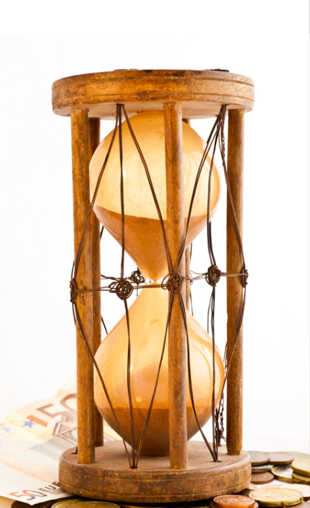
This ancient hourglass was made in India in 1850 and is designed such that the unit of time measurement was ‘hour’. The device is intricately designed and tested to ensure that that 1 hour is completed when the entire sand flows from the upper bulb to the lower bulb. You can then invert the hourglass in order to measure another hour. The symmetric design of the upper and lower bulbs ensures that the same duration of 1 hour is measured regardless of how the hourglass is oriented.
Water Clocks (Clepsydra)
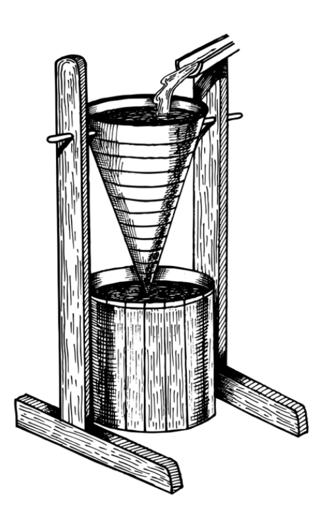
The water clock or ‘clepsydra’ shown above was invented in ancient Egypt around 1417 BC during the reign of Amenhotep III. It is an ‘outflow’ water clock where the water flows from the cone-shaped stone vessel on top into the other vessel below through a small opening. As a result the water level in the top vessel decreases with time. The numbers 1 – 12 on the upper vessel indicated twelve hours of daylight and twelve hours of darkness. The numbers of hours passed could be estimated based on the current water level. The advantage of this water clock over the sundial is that it works at night as well while the sundial works only during the day when there is sunlight. The unit of time measurement was of course in ‘hour’.
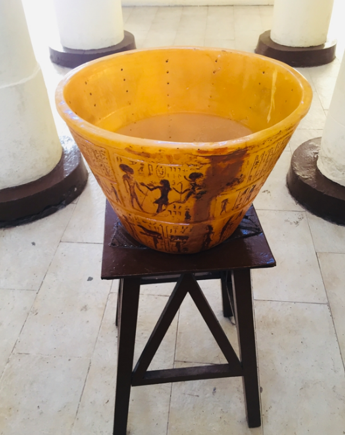
This ancient pharaoh outflow water clock sits in the Pharaonic museum in Egypt, Cairo. It is estimated to have been in use around the 16th century BC. The vessel was filled with water and the numerous small holes in the body were designed to allow uniform outflow of water. The water level inside progressively decreased and the time was indicated by the current water level inside the bucket relative to the markings. The unit of time measurement was of course in ‘hour’.
Obelisks
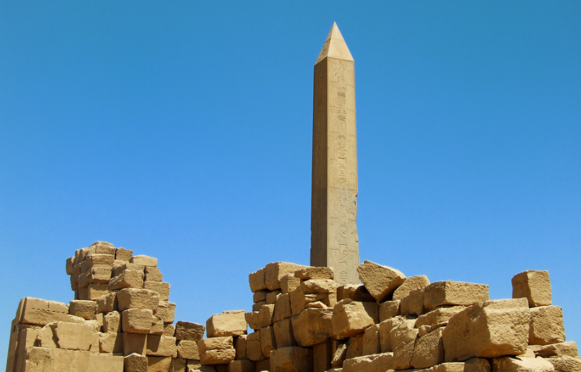
Obelisks such as the Obelisk of Thutmose I which marks the entrance to the Karnak Temple in Luxor, Egypt were used as a type of giant sundial to tell the time. This particular obelisk was built later during the reign of Thutmose I (1493-1479 B.C), although the first obelisks were built as early as 3500 BC.
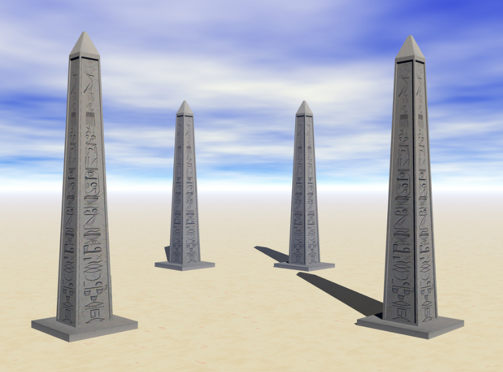
Look at the graphic above. The shadows cast by the obelisks move across the ground as the day progresses indicating the time. So, the tall obelisk acts as a giant gnomon to cast the shadow on the ground. The ancient Egyptians used this simple but effective idea to estimate the time of the day accurately.
Astronomical Clock
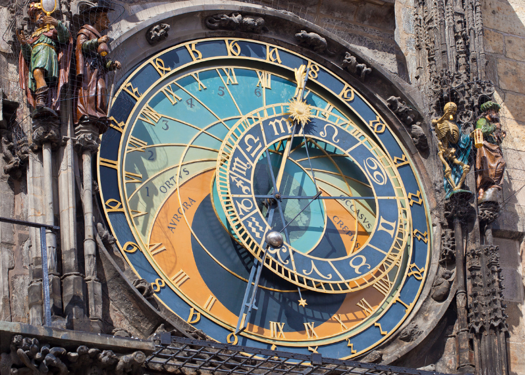
The medieval astronomical clock on the Old Town Hall in Prague, Czech Republic has been in use since 1410. In addition to telling the time, it also gives us a lot of astronomical information. The time telling part of the clock shown in the figure above consists of a smaller inner movable ring and an outer movable ring. The smaller inner ring is called the zodiacal ring and is marked with the signs of the zodiac. The Roman numerals indicate the local time in Prague and the golden Schwabacher numbers on the outer edge of the clock represent the Old Czech time. Do you see the two dials with the golden sun icon and the moon icon at their tips? These dials move across the edge of the zodiacal ring (containing the zodiac signs) and reveal information about the positions of the sun, moon and other astronomical information. The small star which points towards the bottom in the picture also provides useful astronomical information.
Candle Clock
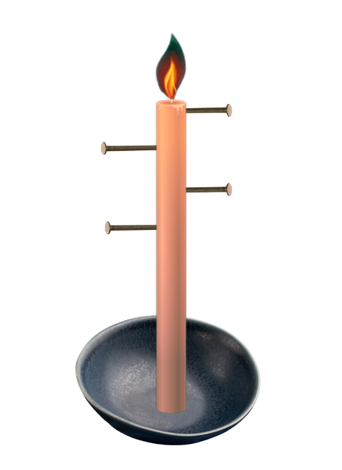
A candle clock like the one used in Rome in the Middle Ages were prepared by making a candle of uniform density and then marking the body at specific intervals. The candle burnt and decreased in size at a steady rate and you could specify the time based on the markings on the body of the candle. You could also set alarms by inserting nails at specific time intervals marked on the body, which then dropped off when the wax melted to that point. Simple design but fairly effective!
“Collect information about time measuring devices that were used in the ancient times in different parts of the world. Prepare a brief write up on each one of them. The write up may include the name of the device, the place of its origin, the period when it was used, the unit in which the time was measured by it and a drawing or photograph of the device, if available.” – Solved.
Related Links:
Solution to Extended Learning Problem 1
Solution to Extended Learning Problem 2
Solution to Extended Learning Problem 3
Solution to Extended Learning Problem 4
Solution to Activity 9.1
Solution to Activity 9.2
Solution to Activity 9.3