

Welcome students! Find excellent solutions to all Chapter 12 exercise questions, extended learning activities, in-text questions, activities along with extra questions of many formats below. We have answered all your questions and included attractive images which will help you study. This is an easy chapter to score from if you put in the effort, so we suggest that you take it very seriously. Good luck!
Solutions to Exercises (Page No 153) of NCERT Class 7 Science Chapter 12 Forests: Our Lifeline –
1. Explain how animals dwelling in the forest help it grow and regenerate.
Answer:
Animals dwelling in the forest help it grow and regenerate by:
- Dispersing seeds by means of defecation.
- Providing nutrients in the decaying dung for the seedlings to grow.
- Converting dead plants and animals to humus from which roots of living plants get nutrients.
2. Explain how forests prevent floods.
Answer:
Forests prevents floods firstly by acting as a giant umbrella which intercepts and distributes the rain. This prevents it from hitting the ground directly. The roots of the forest act as a natural absorber of rainwater. The roots also loosen the soil which allows rainwater to seep through and water does not accumulate.
3. What are decomposers? Name any two of them. What do they do in the forest?
Answer:
Decomposers are organisms and micro-organisms which convert dead plant and animals to humus. Two examples are mushrooms (fungi) and millipedes. The humus they release into the soil by decomposing dead organic matter in forests provides nutrients which are again absorbed by the roots of living plants.
4. Explain the role of forests in maintaining the balance between oxygen and carbon dioxide in the atmosphere.
Answer:
The different plants in forests take in carbon dioxide and release oxygen during photosynthesis. Animals take in this oxygen and release carbon dioxide during respiration which is again taken in by plants to release oxygen during photosynthesis. In this way plants maintain the oxygen-carbon dioxide balance in the atmosphere.
5. Explain why there is no waste in a forest.
Answer:
There is no waste in a forest because decomposers convert dead plant and animals to humus which mixes with the soil. Also, dead animals become food for vultures, crows, jackals and insects. In this way nutrients are cycled and waste does no accumulate.
6. List five products we get from forests.
Answer:
Wood, paper, gums, oil and spices are five products we get from forests.
7. Fill in the blanks:
(a) The insects, butterflies, honeybees and birds help flowering plants in ________.
(b) A forest is a purifier of ________ and ________.
(c) Herbs form the ________ layer in the forest.
(d) The decaying leaves and animal droppings in a forest enrich the ________.
Answers:
(a) The insects, butterflies, honeybees and birds help flowering plants in pollination.
(b) A forest is a purifier of air and water.
(c) Herbs form the lowest layer in the forest.
(d) The decaying leaves and animal droppings in a forest enrich the soil.
8. Why should we worry about the conditions and issues related to forests far from us?
Answer:
Even if forests that disappear are far away carbon dioxide will accumulate in the atmosphere and the earth’s temperature will increase. Animals will lose their habitats, the food chain will get disrupted and new trees will not grow. It will also lead to floods and soil erosion. The ecological balance will thus get disturbed.
9. Explain why there is a need of a variety of animals and plants in a forest.
Answer:
A greater variety of plants and animals helps a forest regenerate, grow and maintain itself. A wide variety of plants provides ample food and habitat for herbivores. Larger number of herbivores provides ample food for a variety of carnivores. Decomposers maintain the supply of nutrients to the soil which are then absorbed by plants.
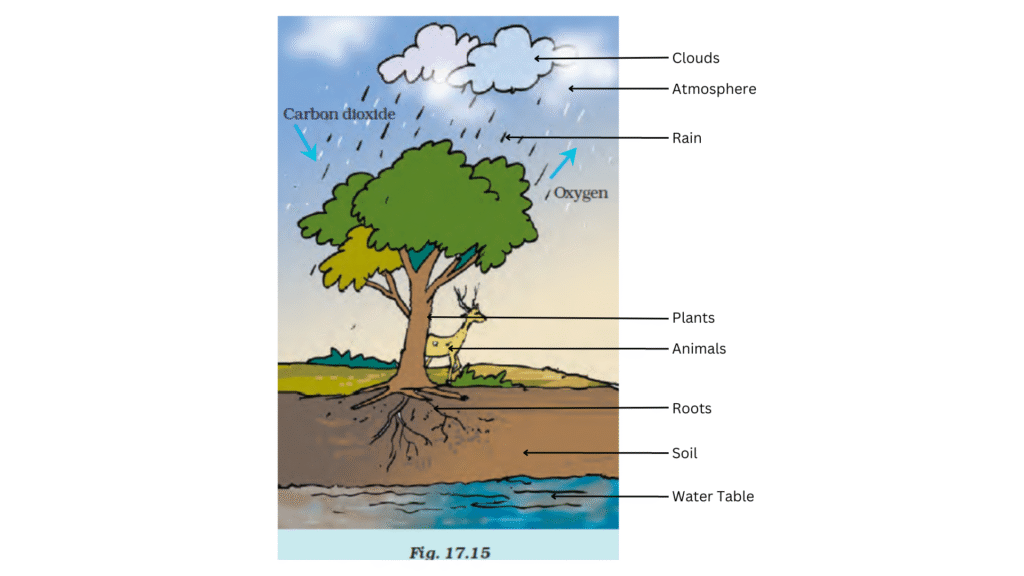
10. In Fig. 12.15, the artist has forgotten to put the labels and directions on the arrows. Mark the directions on the arrows and label the diagram using the following labels: clouds, rain, atmosphere, carbon dioxide, oxygen, plants, animals, soil, roots, water table.
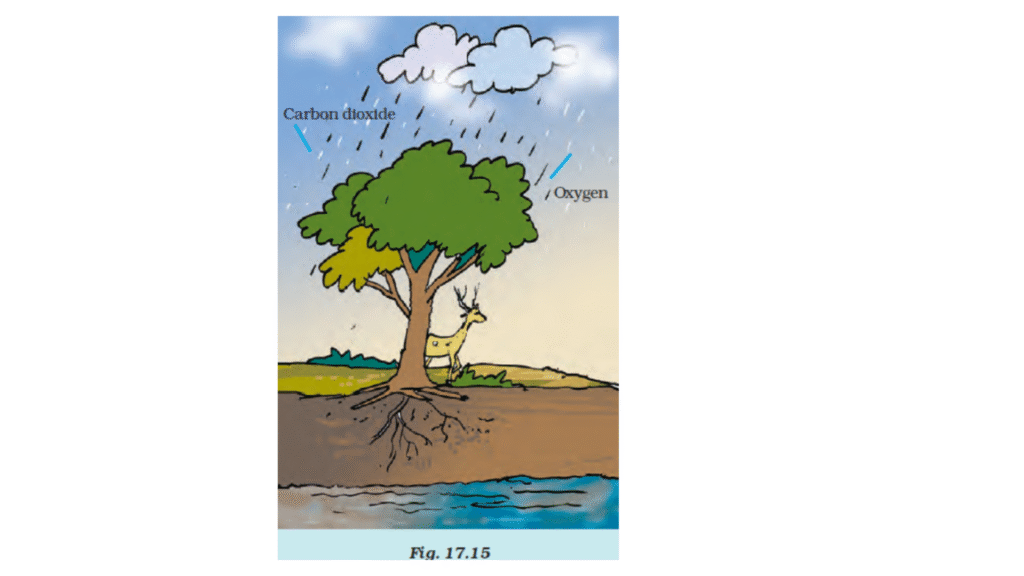
Answer:
The correctly labelled diagram is shown below:
11. Which of the following is not a forest product?
(i) Gum
(ii) Plywood
(iii) Sealing wax
(iv) Kerosene
Answer: (iv) Kerosene.
Keroseneis not a forest product because it is not directly obtained from the forest. Kerosene is chemically obtained from crude oil which is found deep within the earth’s crust. Gum, plywood and sealing wax are all directly obtained from the forest.
12. Which of the following statements is not correct?
(i) Forests protect the soil from erosion.
(ii) Plants and animals in a forest are not dependent on one another.
(iii) Forests influence the climate and water cycle.
(iv) Soil helps forests to grow and regenerate.
Answer: (ii) Plants and animals in a forest are not dependent on one another is the incorrect statement.
Plants are eaten by herbivores and herbivores are eaten by carnivores. Decomposers maintain the supply of nutrients to the soil which are then absorbed by the roots of living plants. Thus, the interdependent food chain is formed.
13. Micro-organisms act upon the dead plants to produce
(i) sand (ii) mushrooms (iii) humus (iv) wood
Answer: (iii) humus is produced when micro-organisms decompose dead plants.
Solutions to Extended Learning – Activities and Projects (Page No 155) of NCERT Class 7 Science Chapter 12 Forests: Our Lifeline:
1. The Department of Environment is to decide whether some portion of a forest in your area could be cleared for a housing complex. Write a letter to the department explaining your point of view as a concerned citizen.
Answer:
Solution to Extended Learning Problem 1
2. Visit a forest. Here is a list of points that would make your visit more fruitful.
(a) Make sure that you have permission to go into the forest.
(b) Make sure that you can find your way around. Get a map and go along with someone who is familiar with the area.
(c) Keep a record of the things you see and do. Observations make the visit interesting. Sketches and photographs are useful.
(d) You may record bird calls.
(e) Collect different kinds of seeds or hard fruits like nuts.
(f) Try to recognise various types of trees, shrubs, herbs etc. Make lists of plants from different places in the forest and of different layers. You may not be able to name all the plants, but it is worth recording and seeing where they grow. Make a record of the approximate heights of plants, crown shape, bark texture, leaf size, and flower colour.
(g) Learn to recognise the animals’ droppings.
(h) Interview the forest officials and the people of surrounding villages and other visitors.
Answers:
Solution to Extended Learning Problem 2
Solutions to In Text Questions of NCERT Class 7 Science Chapter 12 Forests: Our Lifeline –
1. (Page 148) In which layer of the soil would you find humus? What is its importance to the soil?
Answer:
Humus is found in the topmost layer of the soil. Humus contains the nutrients from dead plants and animals which are released into the soil. These are then absorbed by the roots of living plants and used for the plant’s growth.
2. (Page 148) Paheli reminded their friends that they have studied photosynthesis in Chapter 1.
Answer:
Photosynthesis is the process by which plants use the green pigment chlorophyll to convert carbon dioxide from the atmosphere into food and oxygen. This process takes place in the leaves in the presence of sunlight.
3. (Page 148) If there were fewer trees, how will the water cycle be affected?
Answer:
If there were fewer trees there would be less transpiration and less formation of clouds and rainfall. Fewer trees would lead to floods because rain would hit the ground directly and excess water would not be absorbed by roots. It would also lead to depleted groundwater levels because water would not seep through.
4. (Page 149) Paheli remembered that she saw a Pipal sapling on the sidewall in her school. Can you help her to understand how this would have happened?
Answer:
This happened because the Pipal seed got dispersed through bird droppings on the sidewall. When birds eat fruits the seeds are not digested and are excreted out in the droppings. These droppings contain nutrients which are used by the seedlings to grow into new plants.
5. (Page 151) What would happen if it rains heavily in your town?
Answer:
If it rains heavily in my town the water level in lakes and rivers would rise, which would cause flooding. The streets would be waterlogged, there would be power outages and shortage of food. In extreme cases, it would lead to loss of life and property.
6. (Page 151) Boojho asks: What would happen if forests disappear?
Answer:
If forests disappear carbon dioxide will accumulate in the atmosphere and the earth’s temperature will increase. Animals will lose their habitats, the food chain will get disrupted and new trees will not grow. The soil would not hold water which would lead to floods and soil erosion. It would lead to ecological disaster.
Solutions to All Activities of NCERT Class 7 Science Chapter 12 Forests: Our Lifeline –
1. Complete Activity 12.1 (Page 144). Observe the various things in your home and make a list of those which are made from material which may have been obtained from the forest. Based on the products that we get from plants, try to fill Table 12.1. One example of each plant is already given. Fill the table by adding more examples.
Answer:
2. Complete Activity 12.2 (Page 145). Visit a forest or a park in your neighbourhood. Observe the trees and try to identify them. You can take the help of some elders or books on trees. List the characteristics of the trees that you observe, such as the height, shape of leaves, crown, flowers, and fruits. Also draw the crowns of some trees.
Answer:
3. Complete Activity 12.3 (Page 147). Dig a small pit. Put vegetable waste and leaves in it. Cover them with soil. Add some water. After three days, remove the upper layer of the soil. Does the pit feel warm inside?
Answer:
Extra Questions to Complement Solutions to NCERT Class 7 Science Chapter 12 Forests: Our Lifeline –
Very short answer type questions:
1. Name one gas in the atmosphere which will increase if forests are depleted.
Answer:
Carbon dioxide in the atmosphere will increase if forests are depleted.
2. Name a tree that has a weak steam.
Answer:
A climber like a grapevine has a weak stem.
3. Name two spices we can obtain from trees.
Answer:
Two spices we can obtain from trees are turmeric and ginger.
4. What is the shape of the crown of the pine tree?
Answer:
The crown of the pine tree is conical or pyramid shape.
5. What kind of plant is catechu? Name one use.
Answer:
Catechu is an herb. It is used as medicine to treat many diseases.
6. What is gum obtained from the forest used for?
Answer:
Gum is used in the food industry in many different ways and is also used in industrial adhesives.
7. Do all trees have barks?
Answer:
No, all trees do not have barks. Herbs have soft stems and do not have barks.
8. Why is sealing wax called a forest product?
Answer:
Sealing wax is produced from beeswax.
9. Name a tree which does not produce flowers.
Answer:
Pine tree produces brown cones for reproduction instead of flowers.
10. Name the primary source of food in a forest.
Answer:
The primary source of food in a forest are green plants also called autotrophs.
11. Name the top animal in the food chain in a forest.
Answer:
The tiger is the top animal in the food chain in a forest because it is the top predator.
12. Name the tree which would form the uppermost layer of the canopy in the mountain forest.
Answer:
The pine tree grows in mountain forests and is tall enough to form the uppermost layer of the canopy.
Short answer type questions:
1. You enter a jungle with your guide. Suddenly you hear a horde of monkeys calling in the distance. Would it be a good idea to leave?
Answer:
Yes, it would be a good idea to leave just to be on the safe side. This is because animals such as monkeys give warning calls from a distance to alert other members about approaching predators. The call you heard might be a sign of approaching danger.
2. Arrange the following trees in decreasing order of height:
Mango tree, lemongrass, pine, hibiscus.
Answer:
The above trees in decreasing order are: Pine, mango tree, hibiscus, lemongrass. Pine tree is the tallest followed by the mango tree, then the shrub hibiscus and finally the herb lemongrass.
3. Is it right to say that mountain forests are the same as desert forests?
Answer:
Mountain forests are not the same as desert forests because trees and plants in different areas vary according to the climatic conditions. The vegetation in a mountain forest would not be able to grow in a desert where the climate is very dry and hot. Plants such as cacti have adapted to grow in such a climate and are not found in a mountain forest.
4. Name some ways in which seed dispersal happens in a forest.
Answer:
Seed dispersal happens in a forest when thorny seeds cling to animals, travel long distances and germinate. Seed dispersal also happens when animals and birds feed on fruit and scatter the seeds on the forest floor. Sometimes the seeds are swallowed, remain undigested and excreted. The droppings contain nutrients which allow the seed to grow into new plants. Seeds can also be dispersed by wind and water which carry them long distances.
5. Why is the forest floor always warm?
Answer:
Dead and decaying leaves, fruits, seeds, small herbs etc lie on the forest floor and are decomposed by decomposers such as microorganisms and insects. During this chemical decomposition process heat it released which makes the forest floor warm.
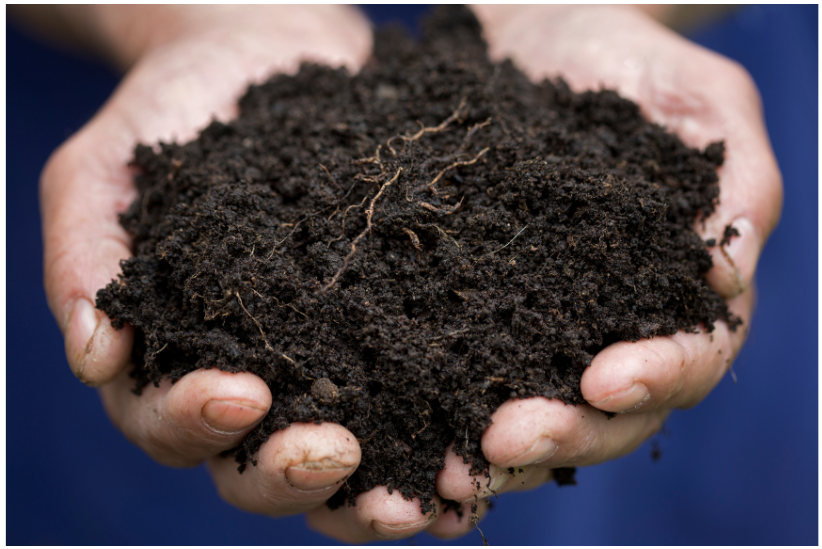
6. Name the substance you see below. Can you tell how it is formed and what its uses are?
Answer:
The substances you see below is humus. Humus is formed when organisms and micro-organisms decompose dead plant and animal matter over a long period of time. Humus is rich in nutrients and are absorbed by the roots of living plants for growth and development. It also enhances soil structure by making it crumbly and increasing porosity, which helps oxygen and water enter the soil.
7. What causes a lot of rain in the rainforest?
Answer:
Rainforests release a lot of moisture by transpiration from the surface of leaves. This makes the air warm and moist and contributes to the overall humidity. This causes frequent rainfall.
8. How does the dense vegetation in the forest provide safety to animals?
Answer:
Birds and animals build nests, burrows etc in the dense foliage to protect their homes from predators. They can also camouflage themselves well in the multicoloured vegetation when being chased by a predator.
9. What would happen if plants are removed from the food chain?
Answer:
Green plants also called autotrophs are the primary source of food in the food chain. Green plants prepare and store food via photosynthesis. Herbivores eat these plants and in turn get eaten by carnivores. Therefore, if green plants are removed the food chain would get disrupted and both herbivores and carnivores would die due to lack of food.
10. How do forests purify water?
Answer:
The roots of plants in forests break up the soil and allow water to seep into the soil. The water percolating through the soil is naturally filtered because the soil traps harmful sediments and pollutants. The roots of plants also absorb nutrients such as nitrogen and phosphorus and thereby purify the water.
Long Answer Type Questions:
1. What would happen to the food chain if the rabbit population drastically decreased.
Answer:
If the rabbit population decreased:
(i) The population of grass would increase because there would be less rabbits to feed on the grass. This would mean decreased competition and more food for other herbivores. Therefore, their population would increase. However, the increasing herbivore population would eventually lead to more competition for scarce resources.
(ii) Fewer rabbits would mean fewer food for the carnivores like the fox. This would lead to increased competition for food and a struggle for survival. The fox population would start decreasing along with that of the other carnivores which eat rabbits.
(iii) Top level predators such as tigers and leopards would be affected by the decreasing fox population. This would mean less food for tigers and leopards and their numbers would start decreasing. This would in turn increase the population of the carnivores they prey on such as foxes. Hence competition for food among carnivores such as foxes would increase.
Thus, we can see that the food chain is interdependent and a single change could bring disaster to the whole ecosystem.
2. List the phenomena in today’s world which pose a danger to forests.
Answer:
The following phenomena in today’s world poses a danger to forests:
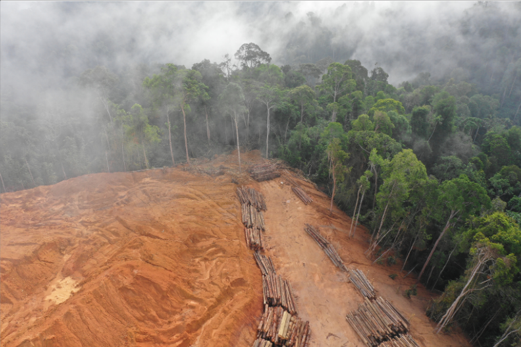
(i) Deforestation: Huge amounts of deforestation take place in today’s world to make way for agriculture, construction and industrial development. This leads to a permanent loss in the number of trees.
(ii) Global Warming and Climate Change: Rising temperature due to global warming and other extreme weather events can disrupt forest ecosystems. This can affect both plant and animal species in the forest.
(iii) Pollution and Industrial Emissions: Pollution from vehicles and industrial emissions contaminate the water and soil in forests. This has adverse impact on plant and animal species and disturbs the forest ecosystem.
(iv) Forest Fires: Natural and human-induced forest fires rage through forests in many parts of the world. This causes widespread loss of habitat and plant and animal life.
3. What can be done to preserve our forests?
Answer:
We can preserve our forests by the following means:
(i) Forest Conversation: Strict laws and regulations should be introduced to prevent illegal cutting of trees and illegal hunting activities. This would protect our existing forests from being depleted.
(ii) Building Nature Reserves and Wildlife Sanctuaries: This would allow diverse plants and animals a safe habitat in which they would thrive. These newly built forests would also contribute positively to our climate, control floods etc.
(iii) Reforestation and Afforestation: Reforestation restores existing forests in which the number of trees has been steadily decreasing. Afforestation means growing new forests by planting of trees. These combined efforts would play a huge role in preserving and expanding our forests.
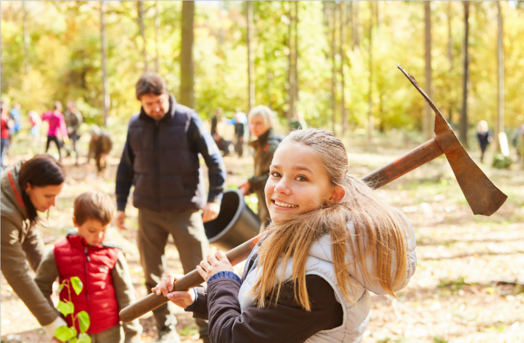
(iv) Building Awareness: We should educate the population at large about the dangers that come with forest depletion. Public service ads and mass media would be an excellent way to broadcast this news and encourage people to take action.
(v) Preventing Climate Change: Forests are affected by changing climatic conditions. Therefore, we should work to reduce greenhouse gas emissions which cause climate change and use clean energy sources instead.
If the above steps are followed then our forests will be preserved and the planet will be a healthier place to live in.
Fill in the Blanks:
highest, groundwater, decrease, recycled, faeces, increase, lowest
(a) You can recognise an animal from its ___________.
(b) Tall trees form the ___________ layer and herbs form the ___________ layer in the forest.
(c) Forest waste is ___________.
(d) Forests help increase ___________ levels.
(e) If forests disappear greenhouse gases in the atmosphere will ___________ and groundwater levels will ___________.
Answers:
(a) You can recognise an animal from its faeces.
(b) Tall trees form the highest layer and herbs form the lowest layer in the forest.
(c) Forest waste is recycled.
(d) Forests help increase groundwater levels.
(e) If forests disappear greenhouse gases in the atmosphere will increase and groundwater levels will decrease.
Match and Pair:
| Column I | Column II |
| (a) Sheesham | (i) Scavenger |
| (b) Vulture | (ii) Decomposers |
| (c) Climate change | (iii) Source of timber |
| (d) Forests | (iv) Effects forest ecosystem |
| (e) Humus | (v) Reduces sound pollution |
Answer: The correct table is shown below:
| Column I | Column II |
| (a) Sheesham | (iii) Source of timber |
| (b) Vulture | (i) Scavenger |
| (c) Climate change | (iv) Effects forest ecosystem |
| (d) Forests | (v) Reduces sound pollution |
| (e) Humus | (ii) Decomposers |
++++++++++++++
Frequently Asked Questions (FAQs) on NCERT Solutions to Class 7 Science Chapter 12 Forests: Our Lifeline –
Our expert team of Indian and foreign-educated teachers, engineers and scientists have answered all the exercise questions, extended learning activities, in-text questions, activities and the self-designed extra questions, to help you thoroughly prepare for your exams. The images we have included will also guide you and give you an idea of what real forests are like.
You can download the free PDFs of the solutions and study them anytime! Want the latest updates and useful material delivered right to your inbox? Then keep visiting our website and subscribe to our email list with one click to be among the first to receive them!
The following topics are covered:
12.1 – Visit to a Forest
Here are the number of problems for the chapter:
(i) Short Answer Type Questions (Questions 1 – 6, 8, 9)
(ii) 1 Fill in the Blanks Type Question (Question 7)
(iii) 1 Label the Diagram Type Question (Question 10)
(v) 3 Multiple Choice Questions (MCQs) (Questions 11 – 13)
Thoroughly understand the vital role of forests, how they are presently endangered and how we can preserve them. You will also see fact-based questions from this chapter in your exams, so study the details well. Our material is an excellent place to start – we have covered the chapter comprehensively and included excellent pictures. Have fun!
If you need expert training, we are there for you! Our teachers follow a structured and rigorous approach to teaching and even mentor students at no extra cost. If you need help, feel free to contact us anytime and we’ll be happy to assist you! (Insert hyperlink)
We offer expert coaching and mentoring and help you reach new heights! Our teacher-mentors not only do an excellent job of teaching, but also mentor students regarding their future careers. This approach helps students to start thinking about their interests and hidden talents early, which gives them an advantage over their competitors.
We provide expert one-on-one coaching and mentoring to you depending on your convenience and needs – have it completely your way! Contact us with your anytime requirements and let us help you out! Book any number of appointments now!