

Hello, young learners!
A heartfelt welcome to this enriching and engaging walk through the chapter “Climates of India.”
Our dedicated team of experienced educators—trained both in India and abroad—has crafted these solutions with great care to make learning enjoyable and easy to grasp. Every question and activity in this chapter has been clearly explained to help you gain a deep and confident understanding of the topic.
Always keep in mind: Learning is a beautiful adventure, and we’re right beside you, ready to support and inspire you every step of the way!
Looking for more support?
We offer high-quality coaching designed to spark your curiosity in Social Science and help you excel in your exams.
Reach out to us anytime—we’re here to help!
Find Solutions to NCERT Class 7 Social Science Exploring Society: India and Beyond Chapter 3 Climates of India, here
The Big Questions
1. What makes India’s climate so diverse?
Answer:
India’s climate is so diverse because of its huge size, diverse topography and its geographic positioning. The Indian subcontinent is a land of contrasts as it has high mountains, plains, deserts, plateaus, and coastal areas – all of which influence temperature and rainfall in different ways. Several factors like latitude, altitude, distance from the sea, wind patterns have an effect on the climate and account for the wide-ranging variety of climates – from the alpine in the Himalayas to the tropical in the south.
2. What are the monsoons? How are they formed?
Answer:
Monsoons are seasonal winds that bring heavy rains to India. Monsoons are formed due to the difference in temperature between land and sea. The monsoon winds display the relationship between temperature, pressure and wind movement.
There are two kinds of monsoon winds:
- Summer Monsoon (Southwest Monsoon): In summer the Asian landmass heats up causing the hot air to rise and creating a powerful low-pressure area above it. Meanwhile, the Indian ocean is relatively cooler as water does not heat up as fast as land, so there is a high-pressure area above the ocean. We know that winds blow from areas of high pressure to areas of low-pressure. So, moisture laden winds from the Indian ocean begin to flow towards the land. These winds carry a large amount of water vapour, and when this moist air rises and cools, it condenses to form clouds, resulting in heavy rainfall. These winds are called the south-west monsoon winds which blow between June and September, bringing rainfall to most parts of India.
- Winter Monsoon (Northeast Monsoon): In winter, the pattern reverses. The land becomes cooler than the sea. Now, the colder land has a high-pressure system over it, while low pressure prevails over the relatively warmer ocean. So, winds blow in the opposite direction, i.e. from the land to the ocean from October to December. These winds are cold and dry and bring dry conditions to Asia and winter to south India, but they pick up moisture as they blow over the Bay of Bengal and cause rain in places like Tamil Nadu. These are known as the winter monsoons.
3. What is the effect of climate on economy, culture and society?
Answer:
Climate plays an important role in shaping the way people live, work, eat, dress, and even celebrate festivals.
It affects the economy by influencing the kind of work people do. For example, in places that get a lot of rain, farmers grow crops like rice, tea, or sugarcane, while in dry areas, they may grow wheat or rear animals like goats and camels. In cold regions, people often keep animals like sheep or yaks for wool and meat. Tourism is also affected by climate—people love to visit beaches during summer or snowy mountains in winter. However, bad weather like floods or droughts can damage crops and homes, causing people to lose money and jobs.
Climate also influences culture, which includes food, clothing, houses, and festivals. In hot places, people wear light cotton clothes to stay cool, while in colder regions, they wear warm woollen clothes. Food habits are determined by the climate—people in cold areas eat hot and fatty foods to stay warm, while those in coastal areas eat more fish. Houses are built differently too. In rainy places like Kerala and Assam roofs are sloped so rainwater can flow off, and in desert areas, homes are made with thick walls to keep the inside cool. Many cultural festivals are also connected to the weather, such as harvest festivals like Pongal in Tamil Nadu or Baisakhi in Punjab.
Lastly, climate also influences society—the way people live together and interact. Most people prefer to live in places with a pleasant and comfortable climate, so such areas often have denser populations. Harsh climates, like deserts or icy mountains, have fewer residents. In places where natural disasters like floods or storms are common, people learn to help and support each other. As the climate changes and becomes more inhospitable, communities learn to work together to protect the environment and use natural resources wisely. In all these ways, climate deeply shapes our economy, culture, and society.
4. How can understanding the climate help us to prepare for natural disasters?
Answer:
Understanding the climate is very helpful because it allows us to be better prepared for natural disasters like floods, droughts, and cyclones.
When meteorologists study climate patterns, they can predict when and where such disasters are likely to happen. This enables the government set up early warning systems to alert people in time, so they can be evacuated from the vulnerable areas and moved to safer places to save their lives and belongings. For example, if we know that a cyclone might hit a coastal area, people living there can be warned in advance, fishermen would not risk their lives by going out to sea, and rescue teams can be prepared to tackle the critical situations.
Understanding climate also helps in building stronger houses, schools, and roads that can withstand disasters like heavy rains or strong winds.
Farmers also benefit from climate knowledge—they can choose the right time to plant crops, use proper irrigation methods during dry periods, and protect their crops from too much rain or heat.
In this way, climate knowledge helps us stay safe, protect our property, and reduce the damage caused by natural disasters.
5. What is climate change? What are its consequences?
Answer:
Climate change means a long-term change in the average temperature and weather patterns of the Earth. It has been accelerated because of human activities, like burning fossil fuels (coal, oil, and gas), cutting down forests, and running large factories that release harmful gases like carbon dioxide into the air. These greenhouse gases trap heat in the Earth’s atmosphere, causing the planet to become warmer—this is called global warming.
The consequences of climate change are severe and affect all living things.
One alarming result is the increase in Earth’s temperature, which leads to melting of polar ice and rising sea levels. This can cause devastating floods in coastal areas.
Climate change also leads to extreme weather events like stronger cyclones, longer droughts, and more heatwaves resulting in forest fires. It can harm animals and plants by destroying their natural habitat, and it can reduce the amount of food we grow, which may lead to food shortages.
Human health is also at risk because of new diseases spreading due to the changing climate.
The looming threat of global water scarcity due to drying up of potable water sources is one of the most pressing threats of climate change.
In short, climate change is a global problem that affects the environment, people, animals, and the future of our planet.
LET’S EXPLORE (Page 47)
Which are your favourite seasons? Write a short essay explaining your reasons.
Answer:
My Favourite Season – Autumn
My favourite season is autumn. After the heavy monsoon rains of July and August, the skies begin to clear in September which marks the arrival of autumn. During this season, white and fluffy clouds, known as cumulus clouds, float gently in the bright blue sky. Sometimes, during early mornings or late evenings, these clouds catch the light of the rising or setting sun and turn shades of gold, pink, and orange, making the sky look magical.
In Delhi, the weather during autumn becomes cool and pleasant. The mornings and evenings feel fresh, and I enjoy basking in the gentle sunshine. It is the perfect time to enjoy nature and spend time outdoors.
Autumn is also the season when many flowers start blooming again. Marigolds, roses, chrysanthemums, and dahlias add splashes of colour to gardens and parks. The flowers brighten up the city and make it look festive.
During this season, we can also feast on tasty and healthy fruits like apples, guavas, oranges, and pomegranates. These fruits are juicy and full of vitamins, and I love eating them during snack time.
Autumn is also the time for festivals like Diwali, Dussehra, and Navratri. These celebrations are full of lights, sweets, and fun moments with family and friends. The mellow weather makes it easier to enjoy these festivals outdoors.
All these reasons make autumn very special to me. The cool breeze, fluffy cumulus clouds floating in the deep blue sky like cotton candy, brightly coloured flowers, and delicious fruits make me feel calm and happy. That’s why autumn is my favourite season of all.
Discuss in groups of three or four and find out whether there are specific events connected to the seasons in your region. Collect information about them — songs, feasts with specific types of food, practices in different seasons, etc. Document these and share your discoveries with your class.
Answer:
Seasonal Events and Traditions in Delhi
In Delhi, each season brings its own unique festivals, foods, songs, and cultural practices. Here’s what we discovered when we discussed seasonal events in groups:
Spring (February – March)
Events & Festivals:
1. Basant Panchami – This festival marks the arrival of spring and is dedicated to Goddess Saraswati. People wear yellow clothes, and kites are flown in some parts of Delhi.
Special foods include sweet saffron rice (meethe chawal), khichdi, and boondi laddoo.
Yellow mustard flowers are used to decorate the altars.
Songs & Music:
The Saraswati Vandana is sung at community celebrations and during morning assemblies in schools. Folk songs praising the beauty of nature and the blooming mustard fields are popular in northern India like “Basant Aayi Re”, “Basant Ki Ritu Mein”.
2. Holi – The joyous festival of colours brings together people from all walks of life, promotes harmony and strengthens bonds.
People gather together and celebrate by throwing coloured powder or gulaal at each other as well as spraying each other with pitchkaris full of coloured water.
Special foods include gujiya, puran poli, dahi bhalla and thandai with a bit of bhang.
Songs & Music:
Dholaks are played and ‘holi’ songs are sung like ‘Holi ayi re kanhai”, “pitchkari” etc and popular Holi songs from Hindi films like “Rang barse”, “Holi ke Din” are also sung with enthusiasm.
Summer (April – June)
Events & Festivals:
Ramadan and Eid – Celebrated with night prayers and delicious feasts especially in areas like Old Delhi (Purani Dilli) near Jama Masjid, where the celebrations are particularly vibrant.
Special Foods that people feast on are biryani, sheer khurma, and seviyan. Traditional drinks like shikanji, jaljeera, and aam panna are enjoyed.
Eid is celebrated with joy, music, and devotional songs,
While Islamic tradition generally emphasizes simplicity and spirituality in worship and celebration (and avoids music in some contexts), nasheeds (Islamic devotional songs) are widely sung or played in homes and community gatherings during Eid-ul-Fitr
A more modern celebratory song that plays on TV, in Muslim homes, and sometimes in community loudspeakers in places like Nizamuddin and Seelampur is:
“Eid Mubarak ho sabko, Eid ka din hai aaya
Khushiyon ka paighaam laya, har dil ne hai muskaraaya”
Monsoon (July – September)
Events & Festivals:
Teej is celebrated especially in nearby Haryana and Rajasthan, but it also influences Delhi culture.
Women wear green clothes, apply mehndi, and sing Teej songs. Swings are tied to trees. Trees look fresh and green, and peacocks are often seen dancing in gardens like Lodhi or Deer Park.
Special food items like ghewar which is traditional sweet are served.
Traditional Teej Songs
1. “Solah Singaar Karungi” – This is a famous Rajasthani folk-style song played during Teej when women adorn themselves with traditional attire and jewellery:
“Solah singaar karungi, piya ke naam ki
Mehendi rachaungi, sajan ke naam ki…
2. “Jhoola Jhool” / “Hariyala Teej Aayi” – Women sing this song while swinging on decorated swings (jhoolas), a key part of Teej.
“Jhoola jhool rahi hai saawan mein
Hariyali Teej aayi re…”
Autumn (October – November)
Events & Festivals:
1. Dussehra – Ramlila performances take place in many parts of Delhi, especially at Red Fort Grounds.
Foods & Sweets: Kheer, gulab jamun, besan laddoo, rasgulla, peda, chana chaat are enjoyed. These sweets are an essential part of the festivities, symbolizing joy, prosperity, and the triumph of good over evil.
Dussehra marks the triumph of good over evil, symbolized by the victory of Lord Ram over Ravana. People sing and perform devotional songs during the festival, especially at Ramlilas (the enactment of Lord Ram’s life story) and community fairs:
Traditional songs:
“Jai Shree Ram” – This is a popular devotional chant, sung to honour Lord Ram during Dussehra celebrations:“Jai Shree Ram, Jai Shree Ram
Ram ki sena ki Jai, Jai Shree Ram…”
“Raghukul Reet Sada Chali Aayi” – This song is often sung during Ramlila performances and pays homage to Lord Ram’s lineage and his virtues.
“Raghukul reet sada chali aayi
Ram, Rajya dharm ki baat samajh aaye…”
2. Diwali –
Diwali is the festival of lights, celebrating the return of Lord Ram to Ayodhya after vanquishing Ravana. The festival is celebrated with prayers, family gatherings, bursting of crackers, and lighting diyas. The songs during Diwali celebrations are festive, devotional, and full of joy.
Foods & Sweets: Kaju katli, soan papdi, and samosas are commonly enjoyed
Traditional Diwali Songs in Delhi:
“Aarti: Om Jai Jagdish Hare”
A traditional Diwali aarti sung in almost every household during the festival to invoke blessings of the divine.“Om Jai Jagdish Hare
Swami Jai Jagdish Hare
Bhakta janon ki Jai…”
“Diwali Aayi Re” (Traditional Diwali Folk Song)
This folk song celebrates the arrival of Diwali, with a cheerful and festive tone. It’s often sung in communities while lighting diyas or during community functions.“Diwali aayi re, Diwali aayi re
Chhake jaay, phuljharriya ki saath…”
Winter (December – January)
Events & Festivals:
Lohri – Lohri is a popular Punjabi festival celebrated primarily in North India, particularly in Punjab,Haryana, and parts of Delhi. It marks the end of the winter season and the beginning of the harvestseason, celebrating the harvest of sugarcane, along with the warmth of the sun and the prosperity it brings. Lohri is often celebrated with bonfires, dancing, and singing traditional folk songs.
Special Foods: Rewaris, popcorn, Gajar ka halwa, sarson ka saag and makki ki roti, and hot soups are popular.
People wear woollens and drink masala chai or kahwa.
Some folk songs associated with Lohri are:
“Sundri Mundri”- This is one of the most iconic and popular Lohri folk songs sung during the festival. It is usually sung around the bonfire, with people dancing to its rhythm. The song celebrates the festival’s spirit and the joys of the harvest season.
“Sundri Mundri, ho…
Teri ek katha sunayiye,
Lo lo lo, lo lo Lohri, ho…
(Sundri Mundri, you tell your story,
Let’s celebrate Lohri, ho…)
“Lo Lohri Lohri”- This song is usually sung to mark the celebratory spirit of the Lohri festival. People dance around the bonfire while singing this energetic and lively tune.“Lo Lohri, Lohri,
Sunte ho, sunte ho,
Balle Balle, Lohri,
Balle Balle, Lohri…”
Christmas –
In Delhi Christmas is celebrated with great enthusiasm and joy, blending traditional Christian customs with the vibrant cultural diversity of the city. People decorate their homes with Christmas trees, lights, and ornaments, and exchange gifts and greetings. There are midnight masses at churches, carol singing, and community celebrations, making it a time for both religious reflection and festive fun. Many people go to churches like St. James Church, Sacred Heart Cathedral, and Cathedral Church of the Redemption and enjoy cakes and decorations. Children eagerly wait for Santa Claus, who is often seen in malls and during festive events, distributing small gifts and candies.
Feasts and Sweets: On Christmas day, families enjoy a grand feast that includes traditional foods like roast turkey, mince pies, fruit cakes, and plum cakes. Indian sweets like kheer, gulab jamun, and ladoos are often served as part of the celebration.
Carol Singing: Groups of people, often from churches or local communities, go carolling in neighbourhoods and shopping areas. The joyful sounds of traditional Christmas carols fill the air, creating a festive atmosphere.
“Jingle Bells” – A classic Christmas song that is popular across the world and often sung during carol singing and gatherings.
“Jingle bells, jingle bells,
Jingle all the way!
Oh! what fun it is to ride
In a one-horse open sleigh…”
“Silent Night”- A beautiful and serene song sung during Christmas Eve services and in many homes, symbolizing peace and joy.
“Silent night, holy night,
All is calm, all is bright,
Round yon Virgin, Mother and Child,
Holy infant so tender and mild,
Sleep in heavenly peace,
Sleep in heavenly peace…”
Delhi is a city where seasons bring joy, colours, and togetherness. Every season has its own flavour — not just in food, but also in the traditions and celebrations. Learning about these makes us feel more connected to our culture and nature.
Do you know which trees in your area change colours before the onset of winter? Are there trees that shed their leaves around this time? Why do you think this happens? Find out and document the local names of these trees.
Answer:
Many trees in my area, i.e. Srinagar, change colour or shed leaves before the onset of winter:
Srinagar, in the beautiful Kashmir Valley, experiences all four seasons distinctly. Autumn here is called “Harud”, and it is especially famous for its colourful landscapes. The trees that change colour and shed leaves before the onset of winter are:
1. Chinar Tree (Platanus orientalis) – Local name: Bouin / Booune
The Chinar leaves turn brilliant shades of red, orange, and gold in autumn.
As the temperature drops and length of daylight decreases, the leaves stop their food-making process. The chlorophyll, i.e. the green pigment in leaves breaks down, and other coloured pigments become visible making the leaves appear yellow, bright orange and even red before they fall off. Leaves fall in autumn primarily as a survival measure to tide over the harsh winters.
2. Poplar Tree (Populus deltoides) – Local name: Frash
In autumn, the leaves of poplars turn yellow before falling.
Poplars shed their leaves in autumn to conserve water and energy during the harsh winter.
3. Willow Tree (Salix spp.) – Local name: Veer
In autumn the leaves of the willow trees turn pale and fall off. This process is necessary to avoid moisture loss in the cold season.
4. Mulberry Tree (Morus alba) – Local name: Toot
Leaves of the mulberry trees turn yellow and shed completely. Shedding of leaves in autumn helps the tree survive the cold and snow.
Why Do These Trees Shed Their Leaves?
Answer:
Autumn (Harud) brings cooler days and less sunlight.
During this season, trees stop making food, and the chlorophyll fades, allowing other colour pigments present in the leaves to show. By shedding leaves, the trees conserve energy and reduce water loss to protect themselves and stay dormant through freezing winter months.
Let’s Remember (Page 49)
We studied about latitudes in Grade 6. Do you remember that latitudes measure the distance from the Equator, increasing as we move away from it (either northward or southward)? While the climate around the Equator is extremely hot, as the latitude increases it becomes temperate and then cold or frigid. Why is this so?
Answer:
Yes, we studied that latitudes are imaginary lines that run parallel to the Equator and help measure how far a place is from the Equator.
The sun’s rays hit the Equator directly and vertically, so areas near the Equator receive the overhead rays of the sun which means more concentrated sunlight and heat throughout the year. That’s why it’s usually hot and humid there.
The climate becomes colder as we move away from the Equator towards the poles. As we move towards the poles (higher latitudes), the sun’s rays strike the Earth at a slant because the earth is curved. This means the same amount of sunlight is spread over a larger area and passes through more of the Earth’s atmosphere. As a result, these places receive less heat, making them cooler. That’s why regions near the poles have cold or frigid climates.
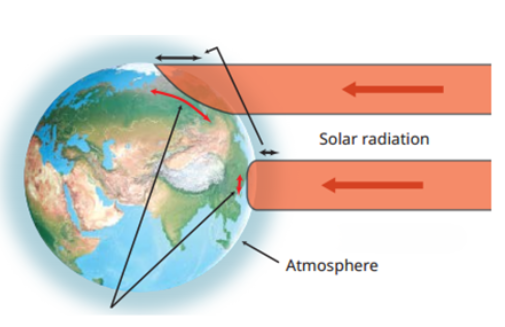
At the equator the sun’s rays are perpendicular so their heat is concentrated over a smaller area, but near the poles the sunrays are oblique or slanted, so the same amount of heat is is dispersed over a wider area, that is why it gets colder as we move further and further away from the equator.
LET’S EXPLORE (Page 51)
Udhagamandalam (Ooty) and Coimbatore are almost at the same latitude. The range of summer temperatures in Ooty is 10–25° while that in Coimbatore is 25 –38°. Why do you think there is such a difference in temperature between these two places?
Answer:
Ooty (Udhagamandalam) and Coimbatore are located at almost the same latitude, which means they are equally distant from the equator. However, there is a big difference in their summer temperatures because of the difference in their altitude (height above sea level).
Ooty is a hill station located at a high altitude (about 2,240 meters or 7,350 feet above sea level) in the Nilgiri Hills. Higher altitudes have cooler temperatures because as we go up in height, the air becomes thinner and cooler. So, even in summer, Ooty stays pleasant with temperatures ranging from 10°C to 25°C.
Coimbatore, on the other hand, is located at a much lower in altitude (about 411 meters or 1,348 feet above sea level). The sun’s heat is stronger at lower altitudes, and the land heats up more quickly. So, Coimbatore experiences much hotter summers, with temperatures ranging from 25°C to 38°C.
Therefore, even though Ooty and Coimbatore are at the same latitude, the difference in altitude causes a big difference in their temperatures. Ooty is cooler because it is high up in the hills, while Coimbatore is hotter as it is in the lowlands.
LET’S EXPLORE (Page 56)
Since the ability to predict the monsoon rainfall has been an important aspect of life in India, our ancestors observed Nature around them carefully. They developed local traditional knowledge through their experience. This traditional knowledge is an important heritage we must preserve. For example, fishermen on the Konkan coast predict the onset of the monsoon when fishes that normally stay under water are seen at the surface; in parts of southern India monsoon is said to arrive within 50 days after the Golden Shower tree (Cassia fistula) blossoms. Some communities also believe that when crows build their nests high on tree-tops, it indicates less rainfall, whereas if the nests are lower, rainfall is likely to be heavy. Make a list of such local knowledge about rain, fog, snow or hail in your area.
Answer:
Here is a list of traditional local knowledge and beliefs about weather in Delhi Region:
1. Ants Moving in Lines
When black ants start moving in long, straight lines or carry food hurriedly, people believe rain is likely within a day or two.
2. Cloud Patterns
Puffy, rising white clouds in the afternoon during summer are believed to indicate that a thunderstorm or rain is on its way.
3. Halo Around the Sun or Moon
A ring (halo) around the sun or moon is often taken as a sign of rain.
4. Frogs Croaking Loudly
Increased croaking of frogs in the evening is believed to herald the arrival of the rainy season.
5. Crows Bathing in Dust
If crows or sparrows are seen rolling in dust or flapping wings on the ground, it’s believed that rain will come soon.
6. Sudden Stillness and Silence
A calm and still early morning atmosphere, with very little wind, is said to signal thick fog ahead.
7. Hazy Full Moon
If the full moon appears blurred, it’s believed that there will be fog the next morning.
8. Street Dogs Sleeping in Groups
Locals say that when street dogs sleep close together or curl up tightly, it is a sign of extreme cold and fog.
9. Cold Winds from the North
If chilly, dry winds blow from the north for several days, people say that snowfall has occurred in the hills and colder days will follow in Delhi.
10. Sharp Drop in Temperature with Dark Clouds
A sudden chill and dark, dense clouds forming in the sky—especially in March or April—are indicative of an impending hailstorm.
11. Birds Flying Low
When birds fly unusually low or disappear suddenly in summer afternoons, people expect a storm or hail.
LET’S EXPLORE (Page 56)
Reach out to your grandparents or elders in your neighbourhood. Ask them about the traditional festivals and dances they remember from their childhood and youth, especially those related to agriculture and rain. What rituals did they participate in? Then organise a cultural fest with your friends. You can showcase some of the dances, songs and activities your elders shared with you. Whether it is a dance, harvest ritual, or a simple story about a prayer to rain gods, try to bring these traditions to life for your classmates.
Answer:
Recapitulating Traditional Festivals and Dances: A Cultural Fest Idea
When we spoke to our grandparents and elders in our neighbourhood, they shared many memories of the festivals and dances they enjoyed during their childhood. These traditions were deeply connected to farming, rain, and the seasons. Here are some of the stories and rituals they told us about:
Agricultural and Rain-Related Festivals Remembered
Teej and Hariyali Teej
Celebrated by women during the monsoon season, praying for good rains and happy marriages.
Swings were hung on trees, and women wore green clothes, applied mehendi (henna), and sang Teej geet.
Gugga Naumi (in nearby Haryana and Western UP)
A festival seeking protection from snakes and rain-related illnesses. People sang folk songs and told stories of Gugga Pir, a legendary protector.
Kajari Teej
Sung in the month of Shravan, especially when the sky is overcast and the crops begin to grow. Kajari songs were sung by women to express longing and celebrate the rains.
Baisakhi (though more common in Punjab)
Some elders recalled celebrations marking the wheat harvest in April. Traditional dances like bhangra and gidda were performed.
Basant Panchami
Associated with mustard blooms and the end of winter. Children flew kites and people offered yellow sweets and wore yellow clothes.
Traditional Dances and Songs
Folk Dances: Though Delhi itself is urban, nearby villages practised simple rain dances where groups would clap, sing folk songs and perform circle dances.
Songs for Rain:
“Barso re megha megha” – sung to welcome rain.
Local folk songs pleading the Indra Devta (rain god) for timely showers.
Rituals and Beliefs
People made small clay idols of rain gods or goddesses and offered them prayers.
In some cases, a group of children would walk through the streets with small pots, singing songs to ask neighbours for water to pour on plants—hoping it would bring rain.
Some elders remembered rituals where the plough would be worshipped before sowing seeds after the first rainfall.
Here are a few suggestions for organising a colourful Cultural Fest with friends:
Dance performances may be staged:
We can recreate a traditional rain dance or Teej swing songs involving the students of our class.
Storytelling Corner: We can invite elders of our community to share stories and legends connected to rain and farming.
Hold a Song Competition: We could have a competition of folk songs like Kajri or Gugga songs.
Display Booth: We can collect traditional tools, festival clothing, and crafts to display in a booth so that everyone is aware of the traditional tools, clothing and crafts.
Food Stalls: Serve seasonal delicacies like kheer, puri-aloo, malpua, and besan laddoos.
LET’S EXPLORE (Page 60)
Have you seen or read about floods? Look at the physical map of India. Discuss in pairs why you think floods occur in the areas mentioned above. (States such as Uttar Pradesh, Bihar, Kerala, Andhra Pradesh and Assam are particularly vulnerable to floods).
Answer:
Yes, I have seen devastating scenes of floods on television and read many reports about the damages caused by floods. They occur when rivers overflow, or heavy rainfall happens within a short time, or when drainage systems fail.
Reasons why floods happen in certain states of India are discussed below:
1. Uttar Pradesh and Bihar
These states lie in the Indo-Gangetic plain, which is flat and low-lying. Rivers like the Ganga, Yamuna, and Ghaghra flow through this region. Melting of Himalayan glaciers adds more water to rivers in summer. And during the monsoon season, the water volume in these rivers swells further due to heavy rainfall causing the rivers to overflow. Poor drainage and build-up of silt in rivers also contribute to flooding.
2. Assam
Assam is located in the northeast and is crossed by the mighty Brahmaputra River. The Brahmaputra receives heavy rainfall and has a strong current. The river changes its course frequently and carries a lot of silt, which raises the riverbed. The monsoon rains combined with water from melting anow of mountainous areas like Arunachal Pradesh cause severe floods. Flooding is worsened by deforestation and poor water management.
3. Kerala
Kerala lies on the western coast and receives very heavy rainfall during the southwest monsoon. In 2018, for example, Kerala experienced a severe flood due to unusually high rainfall and sudden water release from dams. Hilly terrain, blocked drainage, and landslides can worsen flooding in this state.
4. Andhra Pradesh
It is located on the eastern coastal plains and is often hit by cyclones from the Bay of Bengal. These cyclones bring heavy rains and storm surges, leading to flooding. Rivers like the Godavari and Krishna can also overflow during intense rains.
Floods are caused in these areas due to a mix of heavy monsoon rains, river overflow, low-lying land, silting of river beds, poor drainage, and sometimes cyclones. Studying physical maps and river systems helps us understand where and why these disasters occur.
LET’S EXPLORE (Page 62)
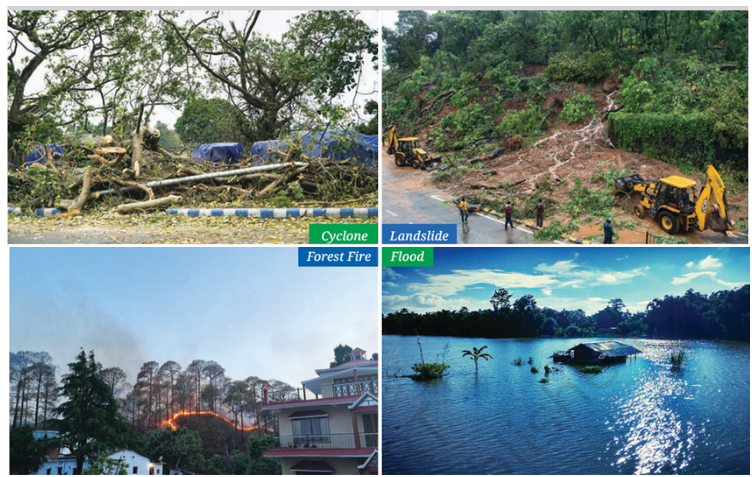
Observe Fig. 3.15. Describe the effects they may have on people, plants, animals and economic life. In groups of four or five, identify in each of the above disasters the part of natural causes and the part of human causes. Compare your conclusions.
Discuss in the same groups series of preventive measures that could help avoid the above disasters.
Answer:
Here is a detailed explanation based on Fig. 3.15
1. Cyclones:
Causes
Cyclones are powerful natural disasters that can have devastating impacts on both human life and the environment.
They are primarily caused when warm moist air over the ocean surface rises creating a low-pressure area below. The rising air cools and condenses forming clouds. The surrounding air with high pressure flows inward to fill the low-pressure area. As the air spirals inward, it picks up speed and forms a rotating wind system which may intensify into a cyclone.
However, human actions also contribute to their intensity and impact—poor urban planning, deforestation along coastal regions, and climate change driven by pollution have all made communities more vulnerable.
Effects
The effects of cyclones are widespread and devastating. For people, they can result in loss of life, serious injuries, the destruction of homes, and mass displacement. Plants and agriculture also suffer as trees are uprooted and crops damaged or destroyed. Animals face dangers such as drowning, loss of natural habitat, and shortages of food. Economically, cyclones disrupt transportation, trade, agriculture, and the power supply in the affected region.
Preventive Measures
To minimise the damage caused by cyclones, several preventive measures can be taken. Early warning systems are crucial to provide timely alerts, allowing communities to prepare and evacuate safely. The construction of cyclone shelters and the development of well-planned evacuation routes can save countless lives. Strengthening buildings in coastal areas and maintaining natural barriers like mangrove forests also play a key role in minimizing destruction. Through a combination of preparedness and environmental conservation, the risks associated with cyclones can be significantly reduced.
2. Landslides
Causes
Landslides are sudden movements of rock, earth, or debris down a slope, often triggered by both natural and human factors. Natural causes include intense or prolonged rainfall, rapid snowmelt, earthquakes, volcanic eruptions, and the presence of steep or unstable slopes. Human activities, such as deforestation, unplanned construction which block the natural flow of water, mining, and improper land use, further increase the risk by weakening the land’s natural stability and drainage capacity.
Effects
The effects of landslides can be devastating. They cause loss of lives, serious injuries, destruction of homes and infrastructure, and forced displacement of entire communities. Animals suffer loss of habitat and loss of life by being be crushed under debris. Environmentally, landslides uproot vegetation, block rivers—leading to secondary flooding—and cause severe soil erosion and degradation. Economically, they damage roads, railways, and power lines, disrupt transportation and communication networks, and cause significant financial loss in sectors like agriculture and tourism.
Preventive Measures
Preventing landslides involves both natural and engineered solutions. Planting trees and preserving existing vegetation help stabilize slopes and reduce erosion. Building retaining walls, improving drainage systems, and regulating construction in high-risk zones are vital structural measures. Additionally, using technology to monitor vulnerable areas and issuing early warnings can save lives and reduce damage by enabling timely evacuation and preparedness.
3. Forest Fires
Causes
Forest fires, also known as wildfires, are uncontrolled fires that spread rapidly through forested areas. They can be ignited by both natural and human causes. Natural causes include lightning strikes and extreme heat or drought conditions that dry out vegetation, making it highly flammable. However, human activities are the leading contributors—these include unattended campfires, discarded cigarettes, deliberate burning, illegal logging, and land clearing practices.
Effects
The effects of forest fires are far-reaching and severe. Environmentally, they destroy vast areas of forests, leading to the loss of biodiversity, destruction of wildlife habitats, and soil degradation. The smoke and ash released pollute the air, affecting both local and global air quality and contributing to climate change. For people, forest fires pose a direct threat to life and property, especially for communities living near forested areas. They can cause respiratory problems due to smoke inhalation, displace thousands of people, and damage homes, infrastructure, and agricultural lands. Economically, the loss of precious timber resources, tourism, and firefighting efforts leads to significant financial burdens for affected regions.
Preventive Measures
Preventing Forest fires requires a combination of public awareness, responsible behaviour, and strict regulations. Educating people and tourists about fire safety, especially in fire-prone areas, is crucial. Proper disposal of flammable materials, avoiding open flames during dry seasons, and creating firebreaks can reduce the risk. Governments should enforce laws against illegal burning and invest in early detection systems, surveillance, and rapid response units to manage outbreaks before they spread. Reforestation and the management of dry vegetation also play a key role in reducing fire hazards and restoring affected ecosystems.
4. Floods
Causes
Floods are natural disasters that occur when water overflows onto land that is usually dry. They are caused by both natural and human factors. Natural causes include heavy or continuous rainfall, rapid melting of snow or glaciers, and storm surges from cyclones or tsunamis. River overflows and poor drainage systems also contribute. Human-induced causes include deforestation, unplanned urban development, encroachment on natural water bodies, and poor waste management, which clogs drainage and worsens water flow during rains.
Effects
The effects of floods can be catastrophic. They lead to the loss of lives and displacement of people, especially in low-lying and densely populated areas. Floodwaters damage homes, schools, hospitals, and roads, disrupting daily life and essential services. Crops are submerged, resulting in food shortages and loss of income for farmers. Waterborne diseases spread rapidly due to contaminated water, posing serious health risks. Economically, floods burden governments with the high costs of rescue operations, rehabilitation, and rebuilding infrastructure.
Preventive measures
Flood prevention and management require a mix of natural and man-made solutions. Constructing dams, embankments, and proper drainage systems can control water flow and prevent overflow. Urban planning should ensure no construction on floodplains of rivers and maintain open spaces and wetlands that absorb excess water. Reforestation helps absorb rainwater and reduce surface runoff. Early warning systems, flood forecasting, and public education campaigns ensure timely evacuations and reduce the impact of floods. With better preparedness and sustainable development, the risks posed by floods can be significantly reduced.
Questions and activities
1. Match the climatic factors with their effects:
| Column A | Column B |
| (1) Latitude | (a) Brings wet air to India during summer |
| (2) Altitude | (b) Creates different climates in the north and south |
| (3) Proximity to the ocean | (c) Keeps higher places cooler |
| (4) Monsoon winds | (d) Moderates the temperature |
Answer:
| Column A | Column B |
| (1) Latitude | (b) Creates different climates in the north and south |
| (2) Altitude | (c) Keeps higher places cooler |
| (3) Proximity to the ocean | (d) Moderates the temperature |
| (4) Monsoon winds | (a) Brings wet air to India during summer |
2. Answer the following questions:
a) What is the difference between weather and climate?
Answer:
The difference between ‘weather’ and ‘climate’ is the length of time during which the atmospheric conditions are described.
‘Weather’ refers to day-to-day atmospheric conditions like whether it is a sunny morning or a rainy one. It includes changes in temperature, rainfall, sunshine, wind and clouds that take place during the short term.
Climate reflects the average weather pattern of a place over a long period, usually several decades.
b) Why do places near the ocean have milder temperatures than places far away from it?
Answer:
Places near the ocean (like Mumbai or Chennai) have milder temperatures than places far away from it because of the moderating influence of the ocean.
Water in the ocean heats up and cools down slowly compared to land. This helps keep the temperature in coastal areas moderate, preventing it from becoming extremely hot in summer or extremely cold in winter.
In contrast, places far from the sea (like Delhi) heat up quickly in summer and cool down quickly in winter, leading to more extreme temperatures.
c) What role do monsoon winds play in affecting India’s climate?
Answer:
The monsoon winds play a vital role in India’s climate. They cause a seasonal change from a hot, dry summer to a rainy monsoon season.
They bring heavy rainfall which is essential for agriculture, and replenishing the fresh water resources like rivers, lakes and reservoirs which are vital for irrigation, drinking water and generation of hydroelectric power.
As summer sets in, the Asian landmass heats up, creating a powerful low-pressure system over it. Since air always flows from high pressure to low pressure, winds blow from the cooler ocean towards the hot land. These south west monsoon winds are moisture laden, so they condense over the warmer land and fall in the form of heavy monsoon rains.
During winter the direction of the wind reverses as cool dry air flows from the cold land (North east) towards the ocean which is warmer. This leads to a cold and dry winter across India with exception of Tamil Nadu which experiences winter rainfall because a part of the north east monsoon winds pick up moisture as they blow over the Bay of Bengal bringing rainfall to parts of Tamil Nadu.
d) Why is Chennai warm or hot throughout the year, while Leh is cold?
Answer:
Chennai is situated near the sea and close to the equator. It lies in a tropical region, so it gets direct sunlight throughout the year. Its proximity to the sea also keeps its temperature moderate, hence it is warm or hot throughout the year.
Leh, in contrast, is located high in the Himalayas. Its high altitude and distance from the sea make it cold throughout the year, with extremely low temperatures, especially in winter.
3. Look at a map of India given at the end of this book. Identify the climate for these cities — Leh, Chennai, Delhi, Panaji and Jaipur.
- Is the place near the sea, in the mountains, or in the desert?
- How do these factors affect the climate there?
Answer:
Here’s a simple and detailed explanation for the climate of Leh, Chennai, Delhi, Panaji, and Jaipur, based on their location (near sea, mountains, or desert) and how it affects their climate:
1. Leh (Ladakh):
Leh is located high up in the Himalayas and at a great distance from the sea, which gives it a cold and dry climate. Because of its high altitude, the air is thin and temperatures remain low. Surrounded by snow-covered mountains, Leh receives very little rainfall. Winters are extremely cold, while summers are cool and dry.
2. Chennai (Tamil Nadu):
Chennai lies on the east coast of India, close to the Bay of Bengal. Its location near the equator gives it a hot and humid climate with moderate seasonal changes. The coastal influence keeps the temperature from becoming too extreme. High humidity is common, and the city gets most of its rainfall during the northeast monsoon.
3. Delhi:
Delhi is situated inland, far from any coastal influence. As a result, it experiences an extreme or continental climate, with very hot summers and cold winters. The lack of proximity to the sea leads to large temperature differences between seasons. In summer, hot dry winds blow across the region, while in winter, cold winds lower the temperatures significantly.
4. Panaji (Goa):
Panaji is on the west coast of India, along the Arabian Sea. This coastal position gives it a warm and humid climate with relatively stable temperatures throughout the year. The southwest monsoon brings heavy rainfall from June to September, making the region lush and green during the rainy season.
5. Jaipur (Rajasthan):
Jaipur lies in a semi-desert area of Rajasthan, near the Thar Desert. Its climate is hot and dry for most of the year. Summers are scorching, while winters are cold. The region receives very little rainfall, and dry winds often blow in during the summer months, adding to the dryness.
4. Draw the monsoon cycle in summers and winters on a map of India. Label where the winds blow in summer and winter. Show the direction of winds during the monsoon.
Answer:
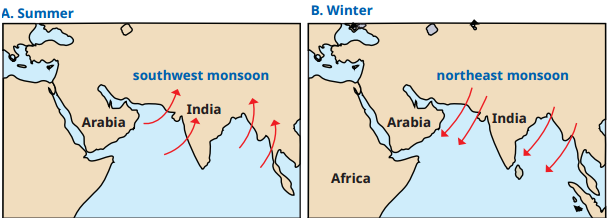
In summer the monsoon winds blow from the cool ocean (high pressure) towards the hot land (Low pressure area) and are known as the South west monsoon winds. In winter, the winds blow from the cold land (high pressure area) towards the warmer ocean (low pressure area) and are known as North east monsoons winds.
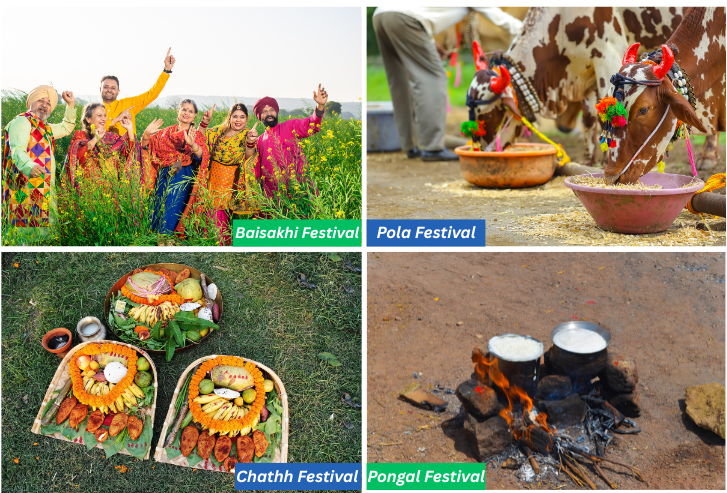
5. Make a colourful poster showing festivals in India linked to farming and weather (e.g., Baisakhi, Onam). Add pictures or drawings of these festivals.
Answer:
Have fun making a colourful poster yourself. A sample is provided below for your reference.
6. Imagine you are a farmer in India. Write a short diary entry about how you would prepare for the rainy season.
Answer:
Diary Entry – Getting Ready for the Rainy Season
June 10
Dear Diary,
Today I worked hard on my farm. The clouds are getting darker, which means the monsoon is near. I cleaned the fields and checked the tools to get ready for sowing rice and maize. My children helped to spread organic compost on the land to make it fertile.
We fixed the bunds around the field so the rainwater doesn’t wash away the soil. My wife has kept seeds ready, and we also bought a few more from the market.
I really hope the rains come on time. A good monsoon means a good harvest for us and sufficient food for my family round the year!
Lakshman Bhuiyan
7. Identify a natural disaster (e.g., cyclone, flood, landslide, or forest fire) and write a short essay that includes the causes and impacts. Suggest actions that individuals, communities and the government can take to reduce the impact.
Answer:
Landslides: Causes, Effects, and How to Stay Safe
Landslides are natural disasters which occur suddenly in mountainous regions when a large amount of rock, soil or mud slides down a slope or mountain. They happen suddenly and cause severe damage and loss of life.
Landslides can happen when rainwater soaks in to the soil making it heavy and loose causing the soil to slide downhill. Earthquakes also can loosen rocks and soil leading to landslides. Building of houses and roads by cutting into hills weaken the slope and cause landslides. Another major man-made cause is the indiscriminate cutting down of trees which removes the roots that bind the soil together.
The effects of landslides are devastating as many houses, roads and fields are buried under soil or rocks. Roads cave in and tumble downhill disrupting transport and communication lines causing severe damage and loss of life, infrastructure and property. People and animals can get hurt or become trapped under the debris. Some may die before the arrival of rescue teams.
To stay safe people should avoid building houses on steep slopes. They should listen to weather forecasts and heed landslide warnings by moving to safer areas. Communities should work together to prevent landslides by planting trees to hold soil together, building walls or barriers to stop soil from sliding and reporting cracks or changes on hillsides early.
The Government should monitor high-risk areas using technology and issue early warnings so that people can take refuge in emergency shelters. It should support those affected by providing food, shelter, and aid.
Landslides are powerful forces of nature that can cause great harm to people, property, and the environment. However, by understanding their causes and taking smart precautions—like protecting forests, avoiding risky construction, and improving early warning systems—we can save lives and reduce damage. With the combined efforts of individuals, communities, and the government, we can build safer, more resilient places to live and protect ourselves from future disasters.