

1. You can make your own sundial and use it to mark the time of the day at your place. First of all find the latitude of your city with the help of an atlas. Cut out a triangular piece of cardboard such that its one angle is equal to the latitude of your place and the angle opposite to it is a right angle. Fix this piece, called gnomon, vertically along a diameter of a circular board as shown in Fig. 13.16. One way to fix the gnomon could be to make a groove along a diameter on the circular board.
Next, select an open space, which receives sunlight for most of the day. Mark a line on the ground along the North-South direction. Place the sundial in the sun as shown in. Mark the position of the tip of the shadow of the gnomon on the circular board as early in the day as possible, say 8:00 AM. Mark the position of the tip of the shadow every hour throughout the day. Draw lines to connect each point marked by you with the centre of the base of the gnomon as shown in the figure. Extend the lines on the circular board up to its periphery. You can use the sundial to read the time of the day at your place. Remember that the gnomon should always be placed in the North-South direction as shown in the figure.
Answer: The above activity can be carried out in the following way:
Aim: To make a working sundial and read the time of the day at your place (in this case Delhi) using it.
Materials Required: Atlas, square piece of cardboard, circular board, protractor, pen.
Procedure:
(i) We choose Delhi as our city. Using the atlas find the latitude of Delhi which is 280 N.
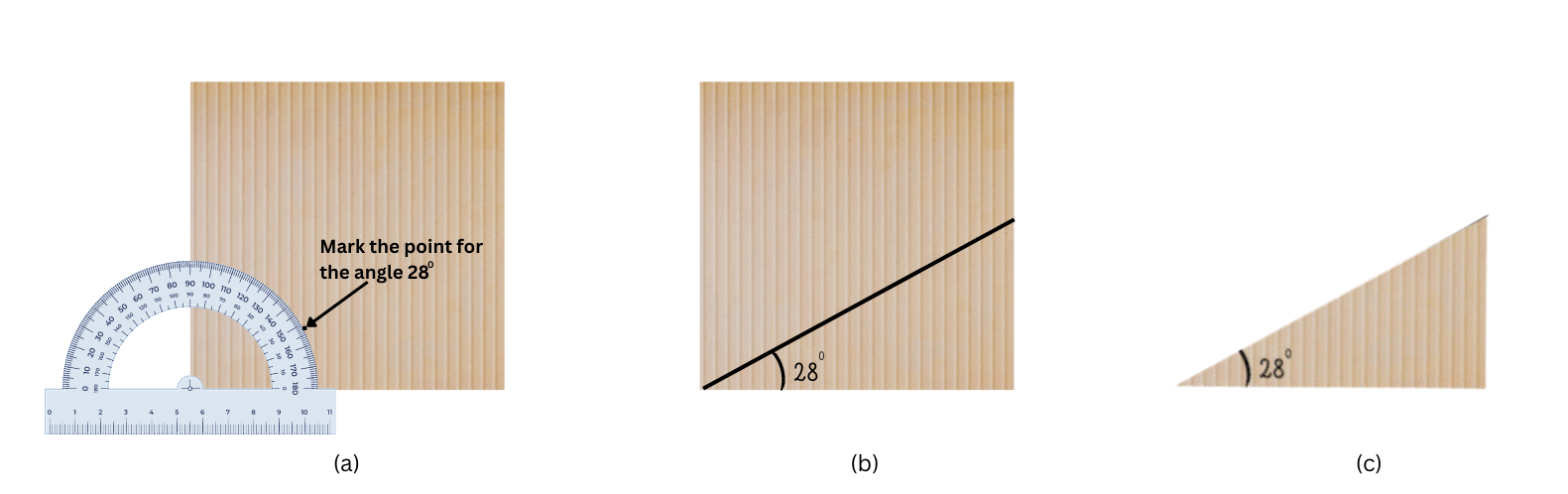
(ii) Now make the gnomon. Take the square cardboard piece, place your protractor on the bottom left corner and mark a 280 angle (equal to the latitude of Delhi) as shown in Figure 1 (a). Then join the point with the bottom left corner and extend it up to the end as shown in Figure 1 (b). Then cut along the line using scissors (use caution while doing this) to get the gnomon as shown in Figure 1 (c).
(iii) Mark a line on the ground along the North-South direction.
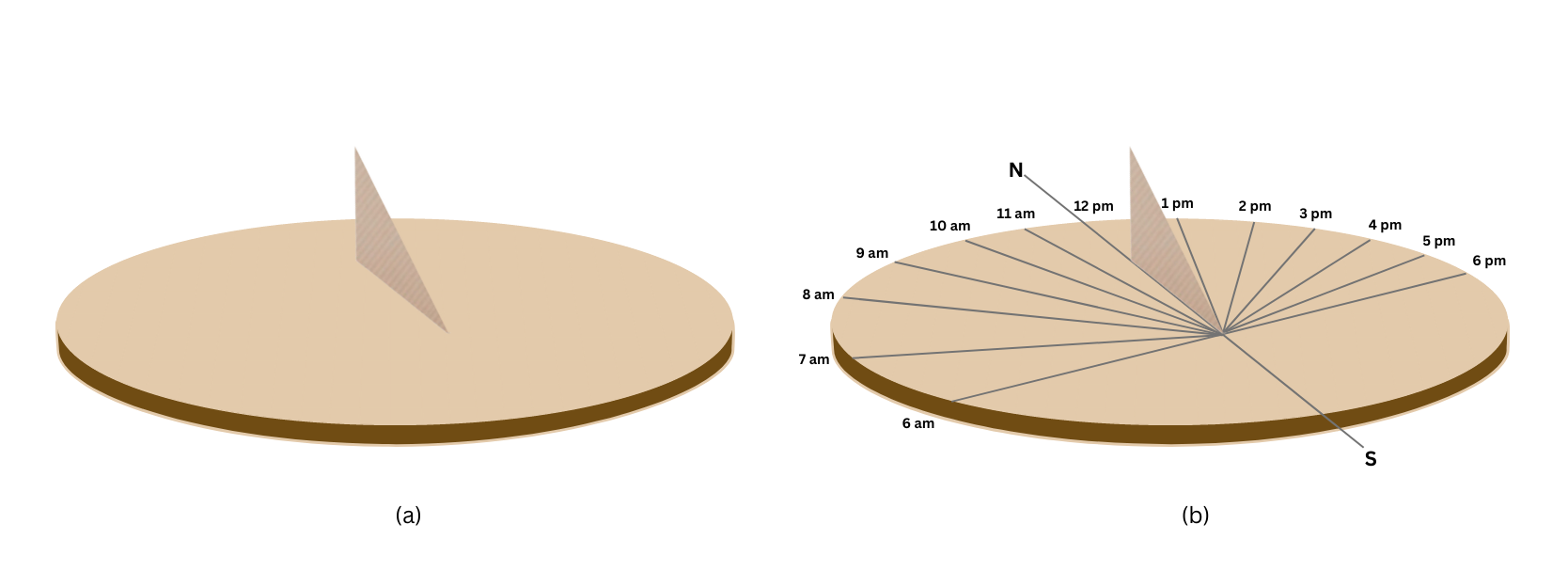
(iv) Make a groove on the circular board and fix the gnomon on it as shown in Figure 2 (a).
(v) Place the board in an open space in broad and continuous sunlight with the base of the gnomon along the North-South direction.
(vi) Keep marking the position of the tip of the shadow every hour throughout the day, starting with 8.00 AM.
(vii) Draw lines to connect each point to the extreme end of the base containing the 280 angle. Your sundial is now ready. This is shown in Figure 2 (b).
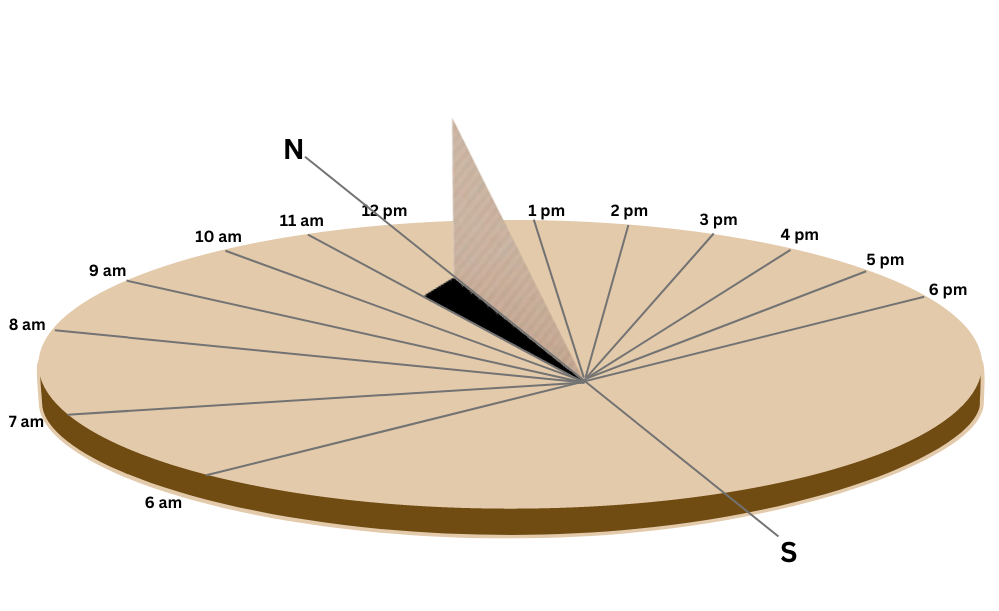
(vi) Now continue to check the time at Delhi using your new sundial. For example, can you tell what the time is right now (Figure 3):
Observations and Conclusions:
- You will find that the shadows cast on the board due to gnomon change orientation throughout the day, suggesting that you can tell the time depending on where the shadow relative to the markings.
- The position of the shadow in Figure 3 indicates that it is 11 am right now in Delhi, our chosen city.
“You can make your own sundial and use it to mark the time of the day at your place. First of all find the latitude of your city with the help of an atlas. Cut out a triangular piece of cardboard such that its one angle is equal to the latitude of your place and the angle opposite to it is a right angle. Fix this piece, called gnomon, vertically along a diameter of a circular board as shown in Fig. 13.16. One way to fix the gnomon could be to make a groove along a diameter on the circular board.
Next, select an open space, which receives sunlight for most of the day. Mark a line on the ground along the North-South direction. Place the sundial in the sun as shown in. Mark the position of the tip of the shadow of the gnomon on the circular board as early in the day as possible, say 8:00 AM. Mark the position of the tip of the shadow every hour throughout the day. Draw lines to connect each point marked by you with the centre of the base of the gnomon as shown in the figure. Extend the lines on the circular board up to its periphery. You can use the sundial to read the time of the day at your place. Remember that the gnomon should always be placed in the North-South direction as shown in the figure.” – Solved.
Related Links:
Solution to Extended Learning Problem 1
Solution to Extended Learning Problem 2
Solution to Extended Learning Problem 3
Solution to Extended Learning Problem 4
Solution to Activity 9.1
Solution to Activity 9.2
Solution to Activity 9.3